


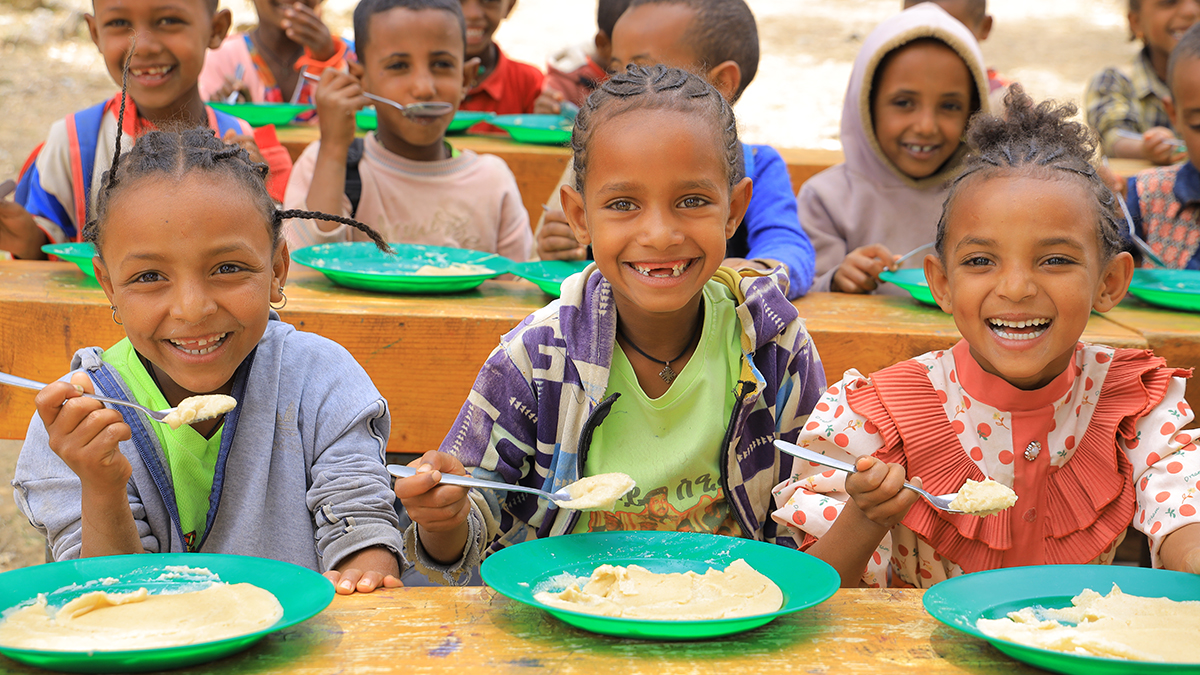
As conflict, rising food prices, and climate shocks continue to drive hunger in the countries where Mary’s Meals works, the global school feeding charity’s recently released 2025 Impact Report shows how nutritious daily meals served in places of learning are helping children attend class, concentrate and progress, while also supporting local economies.
During 2025, Mary’s Meals provided school meals for more than three million children, in more than 6400 schools, across 16 countries – collectively providing more than 400 million meals through its community-led school feeding programs, utilising more than 28,600 metric tonnes of locally procured ingredients. 50.6 per cent of all the meals provided were served to girls.
2025 also saw the charity significantly expand its reach into Ethiopia, Haiti, Liberia, Madagascar, Malawi, South Sudan, Zambia, and Zimbabwe.

Mary’s Meals Australia raises funds for Mary’s Meals International to assist with its charitable activities worldwide.
Research findings from Tigray, Ethiopia, where communities are still recovering from conflict and drought, reveal the school feeding program resulted in a dramatic reduction in children reporting they were hungry at school – from 72 per cent to zero per cent. The number of children leaving school early at least once a month because of hunger also fell from 68 per cent to zero per cent.
In Malawi, Zambia, and Liberia, hunger levels nearly halved after the school meal was served. The proportion of children reporting improved concentration rose from 40 per cent before the meal to 94 per cent afterwards, while teachers reported that student focus rose from 12 per cent to 97 per cent.
Chief Programs Officer at Mary’s Meals International, Erin Pratley said school feeding was one of the most practical ways to support children facing hunger.
“A nutritious daily meal helps children attend, concentrate and take part in class. The impact also reaches beyond the meal itself, supporting learning, and easing pressure on families whose resources are limited,” she said.

In Tigray, Ethiopia, Kidan, a widowed mother-of-three, says the meals her children receive at school help reduce pressure on her household at a time when food prices and income remain uncertain.
“By guaranteeing a meal every day for my children, the program protects me from the fear of rising grain prices and the uncertainty of my modest income,” she said.
Following its expansion last year, Mary’s Meals currently serves local communities in Benin, Ecuador, Ethiopia, Haiti, India, Kenya, Lebanon, Liberia, Madagascar, Malawi, Mozambique, South Sudan, Syria, Yemen, Zambia and Zimbabwe.
Local communities own and run the programs and, wherever possible, meals are made with locally procured food, supporting local economies.
To find out more or to make a donation, visit marysmeals.org.au