

Inspirational reflections on faith, mission and service featured prominently at the recent Leadership Breakfast event hosted by the Knights of the Southern Cross WA.
Three women who hold prominent positions in the areas of mission, outreach and religious education captivated the large audience with their personal reflections on faith, vocation and service that revealed not only the diversity of their journeys, but also a shared commitment to mission in the Archdiocese of Perth.
Their experiences highlighted several unifying themes: the power of lived witness, the importance of formation and community, the reality of non-linear vocational paths, and the enduring call to accompany others in faith.

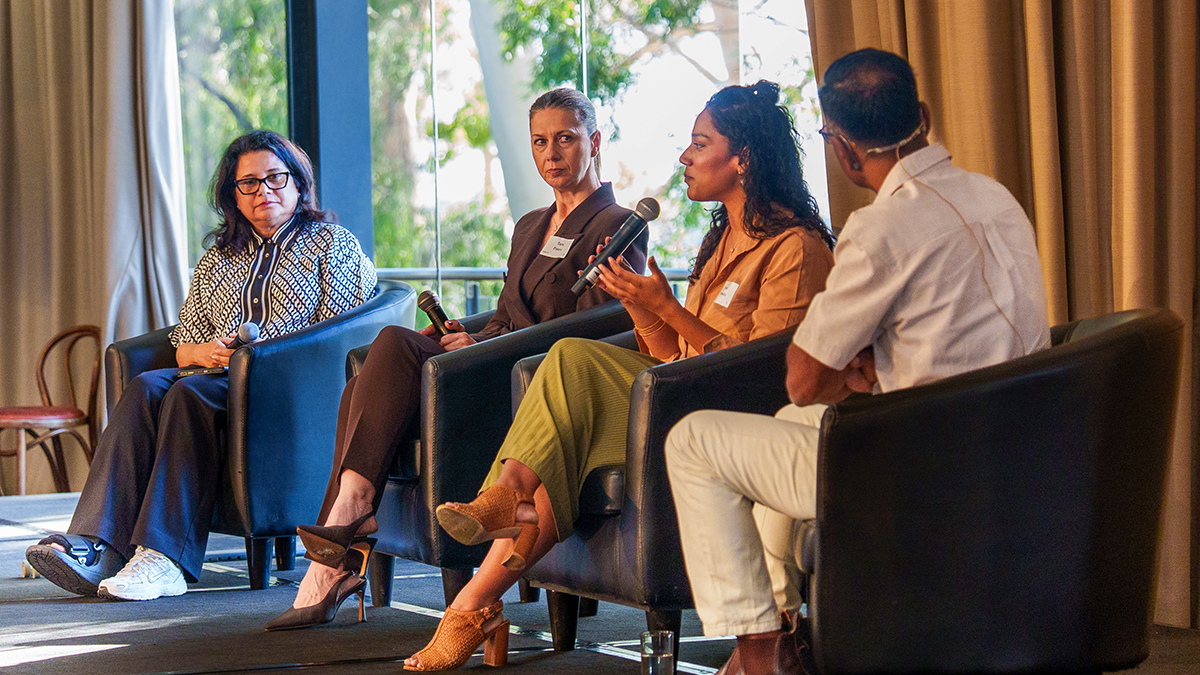
Dr Debra Sayce, Chief of Mission Enhancement and Outreach for the Catholic Archdiocese of Perth, said her life and vocation were shaped by five defining identities – mother, wife, migrant, learner and Catholic. More than just labels, Debra said they were living threads woven into her story of faith, education and service.
A self-described “lifelong learner,” Debra emphasised that education is not simply about acquiring knowledge, but also sharing it in ways that transform lives, particularly with young people.
The integration of faith and learning, she said, underpins her belief that understanding faith requires knowledge. Without formation, faith risks becoming shallow or disconnected. With it, faith becomes something that can be lived, shared, and deepened.
Central to this is the collaboration between family, parish and school. The family, she noted, is the first place where faith is nurtured, while the parish and school build upon that foundation, creating a holistic environment for growth.
Debra’s own journey reflects a deep process of discernment. After nearly two decades in Catholic education, a pilgrimage along the Camino de Santiago prompted her to consider a new direction. Her current role within the Archdiocese represents what she described as a different “expression of mission” – one that supports those working on the frontline of ministry while remaining grounded in the same call to serve and accompany.

Underlying her message was a vision of a Church that is both diverse and united. Drawing on the image of a “house with many rooms,” she affirmed that different spiritualities and charisms enrich the life of the Church. Faith, she acknowledged, is lived in the messiness of everyday life, but it is through encounter – through relationships marked by dignity and respect – that it becomes real.
A similar emphasis on lived faith was shared by Tara Peters, Chief Mission Integration Officer at St John of God Health Care. For Tara, faith was first encountered not through instruction, but through the quiet witness of her mother. This example made faith something practical and tangible, shaping her understanding from an early age.
Her journey, however, was far from linear. Beginning in finance, Tara eventually felt called away from a career that did not reflect her deeper purpose. Her move into Catholic lay ministry marked a significant turning point, leading to sixteen years of service within a faith community. Yet even this chapter came to an unexpected end, leaving her searching for direction.
What followed was a period of uncertainty, including a role in human resources that did not fully align with her sense of calling. Yet, as Tara reflected, it was through these “crooked lines” that God was at work. Her eventual appointment to a leadership role in mission integration brought together her professional experience and her commitment to faith, allowing her to support the formation of caregivers and foster a culture rooted in dignity and human flourishing.
Tara’s story highlighted the importance of trust in the unfolding of vocation. It also pointed to the challenges of mission in contemporary contexts, particularly in articulating the richness of Catholic theology in ways that are accessible and meaningful amid complex ethical realities. Her work seeks to bridge this gap, ensuring that faith remains both authentic and relevant.
For Syona Fernandez, Head of Religious Education at Lumen Christi College, the journey of faith is deeply relational. Raised in a migrant family, she credits her parents and teachers as the first witnesses of faith in her life. Their example, lived out in everyday moments, laid a foundation that would shape her vocation as an educator.
A pivotal moment came in her younger years through the life of Mother Teresa. Inspired by the words, “I’m just a pencil in the hand of God,” Syona embraced a vision of faith centred on availability and service. This desire to be used for a greater purpose became a guiding thread throughout her life.
Like many young people, she experienced challenges in maintaining a strong Christian identity during her teenage years. However, a vibrant parish community provided the formation and support she needed to persevere. Over time, her understanding of mission shifted. While she once imagined serving overseas, she came to recognise a different form of need closer to home – what she described as “spiritual poverty” among young people.
Her participation in World Youth Day in Poland further deepened this insight. Hearing Pope Francis speak about Christ’s presence in the midst of suffering reinforced her commitment to accompaniment. As a teacher, she now seeks to walk alongside students in their struggles, offering not easy answers but a presence grounded in hope and faith.
Together, these stories provided a compelling vision of the Church in Perth today: a community formed by faith, strengthened through collaboration, and sent out in mission. It is a reminder that while each journey is unique, we are all called to contribute – like a pencil in God’s hand.