


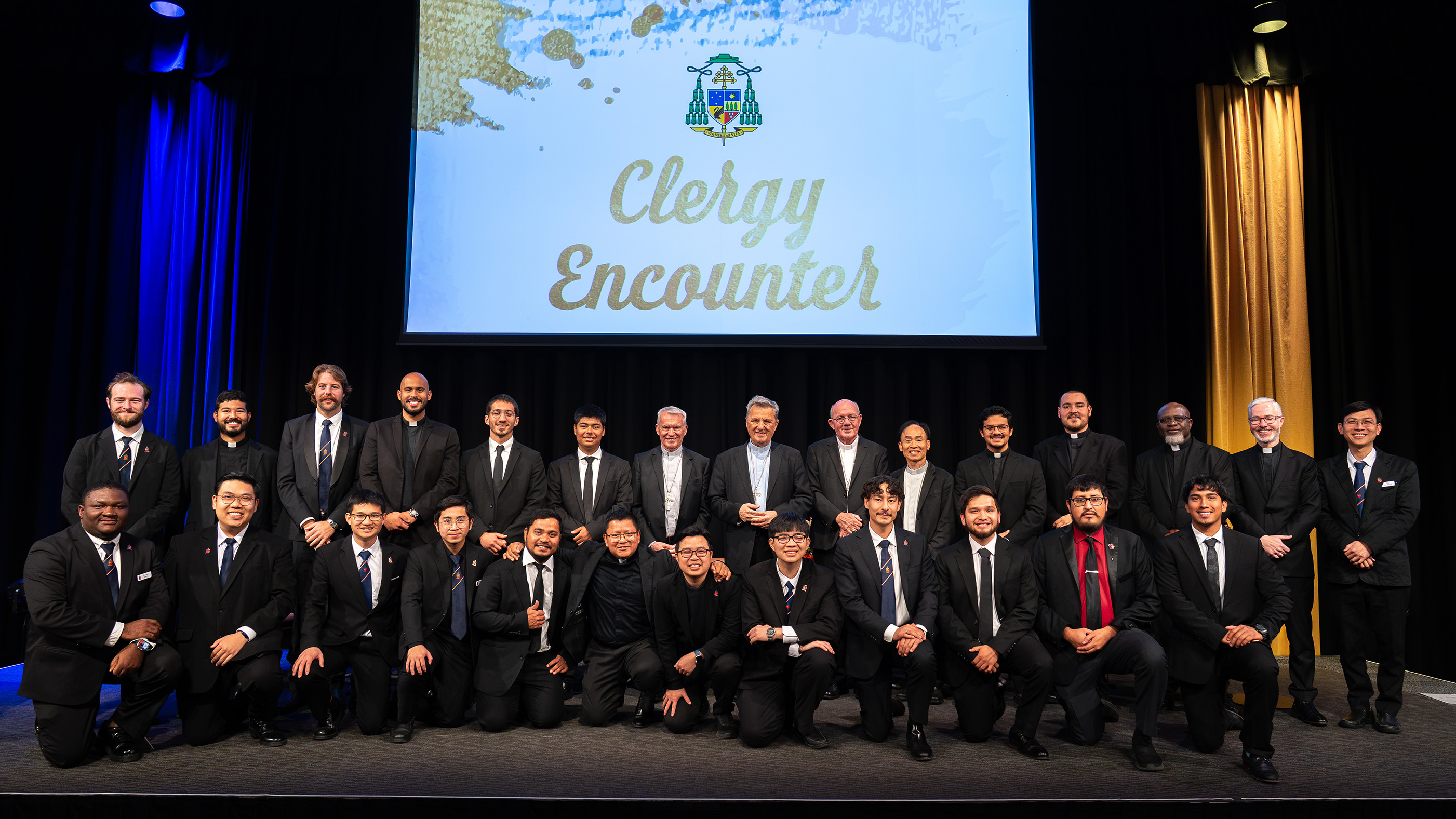
“A synodal church, my dear brothers, does not improvise, but prepares itself,” Secretary General of the Synod Cardinal Mario Grech has told some 200 clergy and seminarians at an encounter in Perth.
Speaking at the Clergy Encounter at John XXIII College, Mt Claremont, on Tuesday 10 November, Cardinal Grech addressed priests’ concerns about synodality and the opportunities for renewing their ministry through shared responsibility.
The Cardinal, who named Perth Archbishop Timothy Costelloe SDB to the Synod’s preparatory commission in 2023, began by recalling what he had learned from brother priests during his years as a diocesan bishop.
“I’m here not to teach but to listen to you,” he said.
Cardinal Grech cited Pope Leo XIV’s Apostolic Letter A Fidelity that Generates the Future, affirming the importance of priestly ministry and cooperation among priests, deacons and the whole People of God.
Priestly shortages and heavy pastoral workloads had left some priests viewing the Synod as another demand on already crowded parish schedules, he acknowledged.
Some bishops had enthusiastically promoted the process, while others had kept diocesan involvement to a minimum, he said.
He acknowledged concerns among priests that greater lay participation diminished their authority or failed to recognise their service.
Participation followed from baptism, he explained. Each member of the People of God shared responsibility for the Church’s mission and the life of the Christian community.

Cardinal Grech distinguished the priesthood from clericalism, which he described as a distorted understanding of ministry that could affect both clergy and laypeople.
“Clergy and clericalism are not synonymous.”
He addressed fears that synodality departed from Catholic tradition, locating its renewal in the Gospel and the Second Vatican Council.
The concerns of priests required careful listening, including attention to those who thought differently.
He outlined four opportunities for priestly ministry, beginning with fraternity and cooperation among priests and their bishop.
An individualistic approach to ministry, he said, contributed to pastoral overload.
Councils of priests and other bodies offered a means for clergy to contribute more effectively to the pastoral direction of their diocese.
Qualified laypeople could assume responsibilities in catechesis, formation and administration, allowing priests greater time for preaching, the sacraments, spiritual direction and the care of people in difficult circumstances.

He spoke of helping the faithful recognise “priests as pastors and not managers”.
Lay participation could carry the Church’s mission into schools, workplaces, hospitals and community organisations beyond the usual reach of parish activities.
That renewal required formation involving clergy and laity together, he said.
He stressed preparation and time for growth, concluding with the Synod’s working document on initial and ongoing formation for all the baptised.
He quoted the document’s call to renew seminary curricula and the training of formators and theology professors.
Irish priest Fr Eamonn Conway, Professor of Integral Human Development at the University of Notre Dame Australia, led the panel session with Cardinal Grech, Archbishop Costelloe, Fr Vincent Conroy and Archdiocesan Director of Vocations Fr Joseph Laundy.
Archbishop Costelloe placed communion and mutual support at the centre of his response.
He encouraged priests to recover the idealism that first drew them to the seminary and ordination, amid the pressures of administration.
“We need to be able to rely on each other. We need to see ourselves as in this together, and that each one of us is responsible for the other,” Archbishop Costelloe said.
Fr Conroy recalled the enthusiasm for diocesan consultation following Vatican II and the patience that listening required.
On Bathurst Island in 1974, he had overheard five Aboriginal people discussing a government report.
Long silences separated the speakers as they reflected on one another’s contributions.
He encouraged priests to approach synodality with “a sense of adventure”.
Fr Laundy reflected on the tendency for a priest to become the parish’s exclusive leader.
He said synodality could help the whole parish discern and build its life together, with participation extending beyond the priest and his committees.


Cardinal Grech affirmed a parish priest’s account of encouraging lay responsibility without always using the term synodality.
“There is no need to use the word synodality.”
Responding to a seminarian, he urged communities to make room for young people, listen to their voices and entrust them with responsibilities.
Children also had a contribution the community needed to hear.
Fr Conway raised concerns about the relationship between consultation and mission, and about priests retaining responsibility while losing authority.
Cardinal Grech said synodality should lead to evangelisation and affirmed the Church’s hierarchical character.
He described discernment as a task involving the whole community, with a particular responsibility for its pastors.
“For me, a synodal church is a church that together tries to understand the will of God.”
He explained that the bishop retained responsibility for the final decision after listening and seeking consensus. The pastor’s ministry included ensuring that the community’s discernment proceeded properly.
Cardinal Grech concluded by conveying Pope Leo XIV’s appreciation for the ministry of bishops and clergy and his blessing.