

As places explicitly dedicated to the formation and support of young people, educational institutions must build communities in which the “God question” is both welcomed and facilitated, Perth Archbishop Timothy Costelloe SDB said recently.
Delivering the homily at the Commissioning Mass on Sunday 12 July for St Thomas More College’s new Head of College, Mim Jones, Archbishop Costelloe reflected on the unique mission of Catholic education, reminding those gathered that every Catholic institution exists not simply to provide an important service, but to participate in the Church’s mission of proclaiming the Gospel.

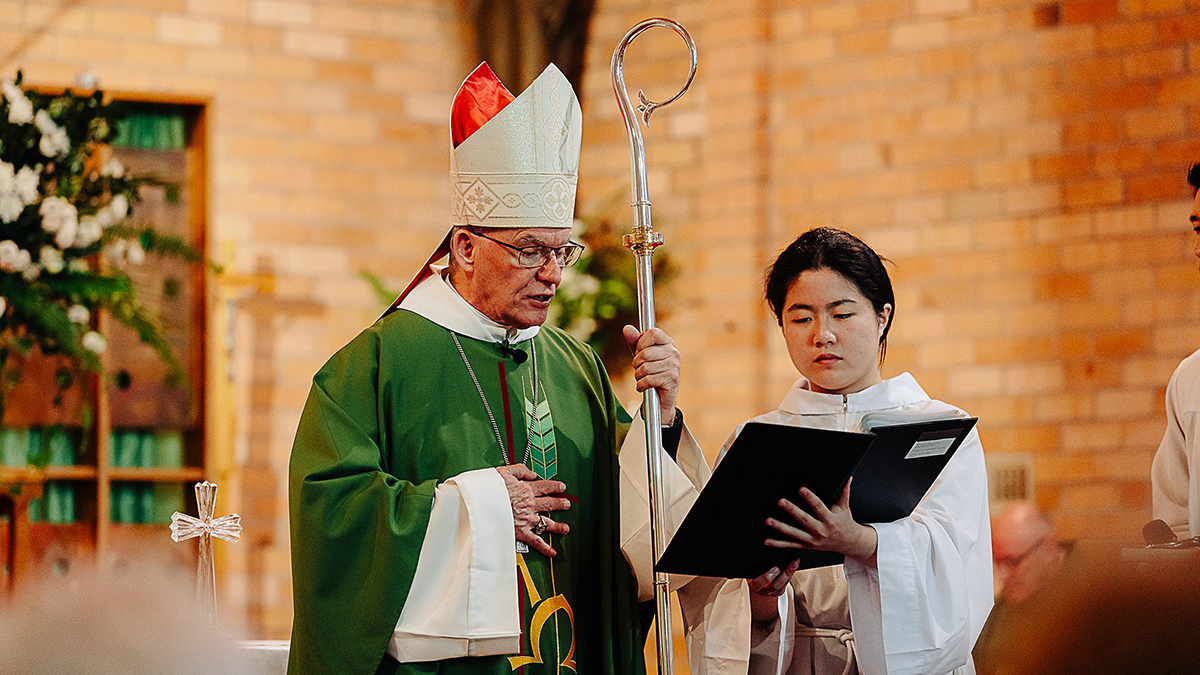
Drawing on the Parable of the Sower, Archbishop Costelloe encouraged the College community to see its mission as one of faithfully sowing the seeds of faith, trusting that God alone brings about the harvest.
He also noted that the celebration of the Eucharist at the commissioning was itself a powerful sign of the College’s Catholic identity, distinguishing it as more than simply another university residential college. Rather, he said, it exists as a “significant expression of the life and mission of the Catholic Church in this Archdiocese and in Western Australia.”
Catholic institutions, he continued, are founded because the Church sees them as both a valuable contribution to society and a response to Christ’s command to “go and make disciples of all nations”.

However, he stressed that this mission must always remain invitational rather than coercive. Quoting the sentiments of both Pope Benedict XVI and Pope Francis, he reminded the congregation that the Church’s role is “to propose endlessly, but never to impose.”
Archbishop Costelloe said every Catholic ministry expresses this mission in ways appropriate to its setting. For a university residential college such as St Thomas More, this means intentionally creating a community where “the God question” is welcomed, explored and supported.
Such an environment enables students to engage thoughtfully with faith while growing academically, socially and personally.

Returning to the parable of The Sower, Archbishop Costelloe said those in service to the Church are called to remain faithful in their mission without becoming discouraged by immediate results.
“The outcome,” he explained, “is ultimately beyond our control.” Rather, disciples are invited to place their trust in God, whose grace alone brings lasting fruit from the seeds that are faithfully planted.
Addressing Mim directly, Archbishop Costelloe acknowledged there were many challenges that accompany leadership; however, he encouraged her to remain focused on nurturing a community where faith can be freely encountered.
“Together with staff and student leaders, it is your privilege to ensure that the God question, and the Christian response to that question are always welcomed and encouraged in the College,” he said.
Faithful leadership, he reminded the congregation, is not measured by visible success alone but by generous service entrusted to God’s providence.
Entrusting Mim’s ministry to the Lord, he prayed that God, who had begun this good work in her, would continue to guide and strengthen her as she leads St Thomas More College into the future.
Faith service and community
In her address, Mim said she accepted her role with “a profound sense of gratitude and humility.” The celebration of the Eucharist, she added, “reminds us that leadership within a Catholic institution is ultimately grounded in faith, service and community.”
Reflecting on her own journey, Mim shared how her appointment as Head of College represented a unique ‘full circle’ experience of residential college life.
Having first experienced a residential college as a student more than two decades ago, Mim said she never imagined she would return to lead the kind of community that provided her with a true sense of belonging and helped shape her own life personally, spiritually and professionally.

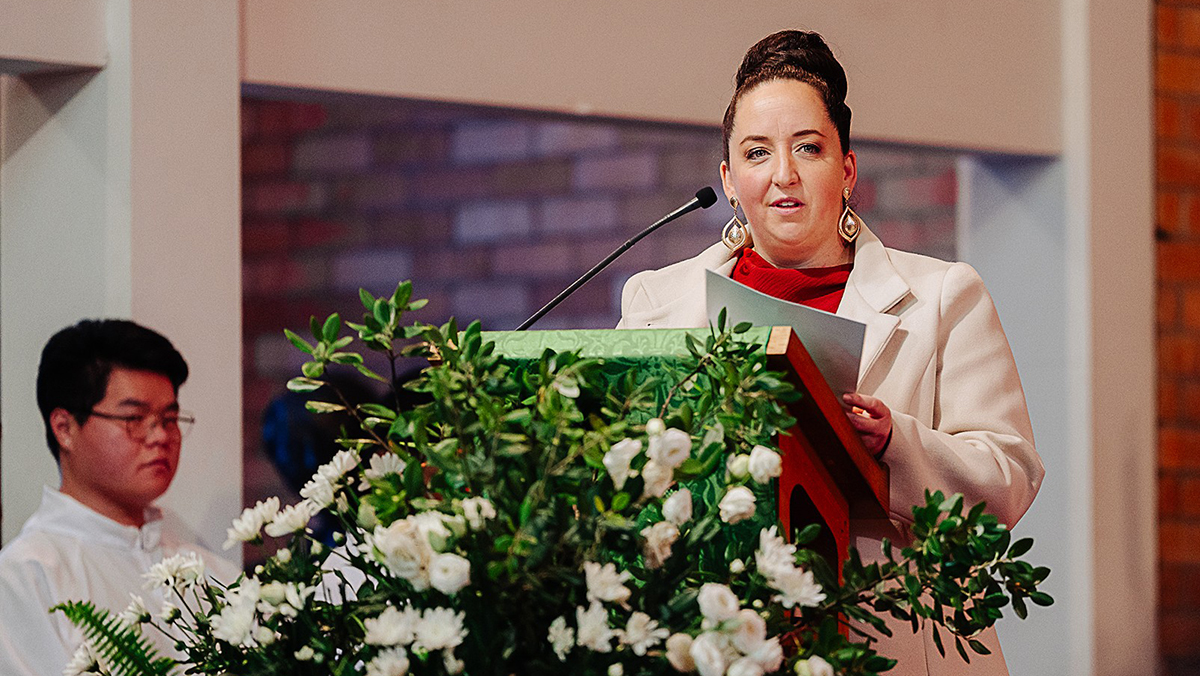
“While we do not always understand God’s plan when we are living it, we are often able to recognise His guidance when we look back,” she said.
As a leader in the College, Mim said she had the privilege of accompanying students through some of their most formative years.
While they may come from diverse cultures and faith traditions, the College strives to foster a community where every person is treated with dignity, encouraged to discover their God-given gifts and inspired to serve others.
“In a world that can often feel increasingly disconnected, uncertain and individualistic, communities like St Thomas More College matter,” she said.
Residential colleges offer far more than accommodation, she added – they provide young adults with a place where they are known, supported and challenged to grow.
By nurturing friendship, leadership, faith, service and personal formation, St Thomas More College seeks to prepare graduates who understand that success is measured not only by academic achievement but also by compassion, integrity and a commitment to the common good.
Acknowledging the guidance and stewardship of mentors, colleagues, previous leaders, family and friends – and the unwavering support of her husband and sons – Mim said leadership is never an individual achievement; it is made possible through the generosity and encouragement of others.
Drawing inspiration from the College’s patron, St Thomas More, Mim continued by saying she would strive to model integrity, courage, compassion, humility and faithful service.
“True leadership is not about status or authority, but about conscience, humility and remaining faithful to what is right, even when it is difficult,” she added.
Entrusting the future of the College to God’s guidance, Mim prayed that St Thomas More College would continue to be a place where young people encounter friendship, discover their purpose, and develop into compassionate leaders committed to serving both the Church and the wider community.
