


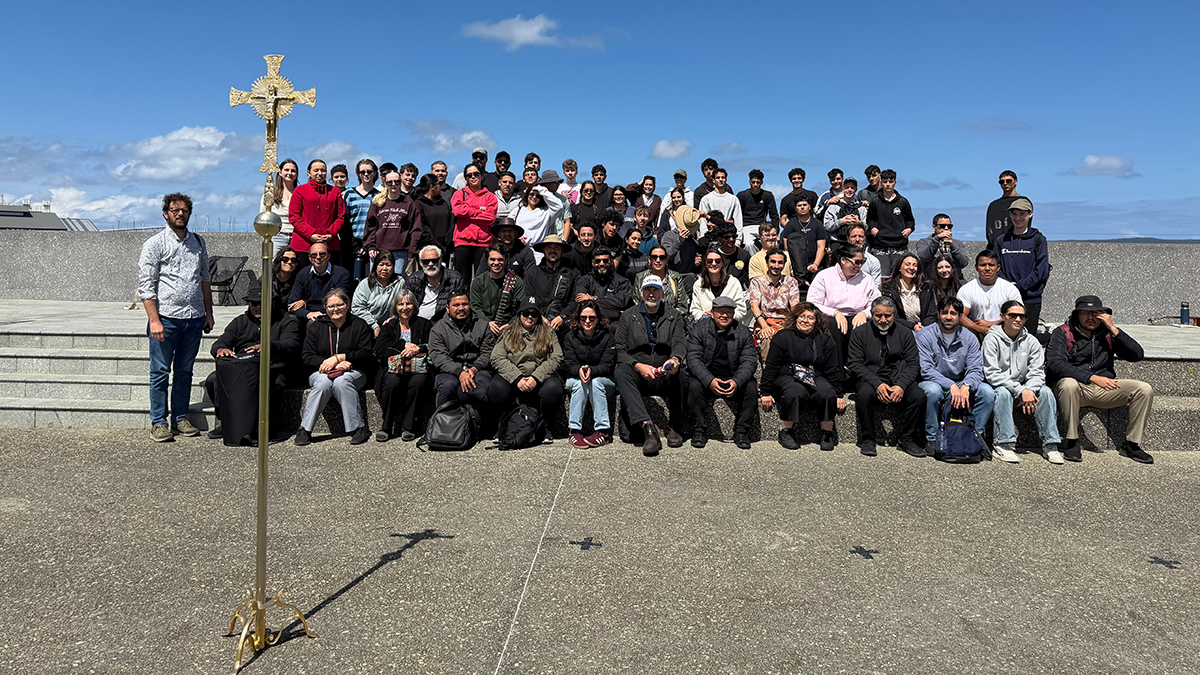
Eighty young Catholics from the Neocatechumenal Way have recently set out across Western Australia’s South West and Great Southern regions to mark the Franciscan Jubilee Year, the 800th anniversary of the death of St Francis of Assisi.
Accompanied by their catechists, priests and seminarians from Redemptoris Mater Seminary, the young people travelled not simply to remember a saint of the past, but to hear anew the call to holiness addressed to every Christian.
A journey begun in penance
The pilgrimage began on Thursday 1 October with a Penitential celebration at Maida Vale Parish St Francis of Assisi Church.
The following morning, the pilgrims travelled from Perth to Bunbury, where they prayed Morning Prayer together in the Cathedral.
From there, the youth continued through Collie, Williams and Kojonup before reaching Albany and Camp Quaranup, whose staff warmly welcomed the group.
Creation, dignity and the human person

On the second day, in front of the beauty of sea, rock and sky at William Bay National Park,they heard a catechesis on St Francis’ Canticle of the Creatures, reflecting on the goodness of creation and the beauty and dignity of the human person.
That reflection opened into questions with particular urgency for young people today.

The group discussed Pope Leo XIV’s encyclical Magnifica Humanitas and the risks artificial intelligence may pose when technological achievement is separated from a proper understanding of human dignity.
The image of the Tower of Babel offered a warning: human beings may be united by ambition and ingenuity yet fall into confusion when God is no longer at the centre of their purpose.
Several talks presented St Francis not as a distant or unattainable figure, but as an ordinary young man with desires, ambitions and plans of his own.
Lead Catechist Francesco Piccolo explained to The Record that the catechesis highlighted that when God called, Francis responded freely and courageously.
“And his fearless vocation inspired a generation of young people in his own time and countless others across the eight centuries since his death,” Mr Piccolo said.
“God calls but does not compel; each person remains free to answer. That answer can itself become an act of resistance to a culture that urges us to live only for ourselves,” he said.
“The Christian vocation is revolutionary because it transforms the person who responds, those around them and, through lives given in faith, the world itself.”
A further catechesis considered the Christian understanding of sexuality and marriage, including a clear discussion of the harm caused by pornography.
“Together, these conversations invited the pilgrims to see faith not as something detached from contemporary life, but as a light by which its most difficult questions can be faced,” Mr Piccolo reinforced.
“May Christ teach you what is yours to do”

Saturday marked the feast of the Transitus, 800 years to the day since the death of St Francis.
In the celebration of the Eucharist, the pilgrims recalled the words traditionally associated with Francis as he approached death: “I have done what is mine to do. May Christ teach you what is yours to do.”
The words gave the anniversary a personal force, Mr Piccolo explained.
“The question was no longer only what Francis had done in his own time, but what Christ might now be asking of each pilgrim,” he said.
Joy carried into the streets

Sunday began with Morning Prayer at St Joseph’s Shrine in Albany. The young people then carried their joy into the streets, singing psalms as they walked to Anzac Peace Park.
There they heard a catechesis on St Clare and her response to God’s call. Priests travelling with the group, together with a missionary catechist, shared their own vocation stories.
“Their witness brought the central message of the pilgrimage into focus: every Christian has a vocation,” Mr Piccolo said.
“Whatever form that calling takes, each person is invited to become a presence of Christ—to love even one’s enemies and to make Him present in the ordinary circumstances of daily life,” he said.
A generation searching for hope
On the return journey to Perth, the young people spoke about what the pilgrimage has meant to them.
“Their reflections were both moving and sobering,” Mr Piccolo continued.
“They described a deeply secularised world in which Christ often seems absent and many friends and family members have lost hope.
“They spoke of their need for reassurance, for a faith strengthened in community, and for help discerning the decisions that shape a life: study, work, marriage and the particular vocation to which God may be calling them.”
Mr Piccolo reinforced this is why pilgrimages such as this are important.
“They allow young people to encounter Christ not only in catechesis and sacrament, but also in one another,” Mr Piccolo said.
“Travelling together as a ‘caravan’ offered a small image of the Church herself: a people on the way, sustained by prayer, companionship and a shared destination,” he said.
The pilgrimage continues
The journey did not end on the road back to Perth.
Each month, the young people are invited to gather for a Scrutatio, reflecting prayerfully on Scripture and receiving catechesis shaped by Pope Leo’s invitation to World Youth Day in Korea.
Some also participate in weekly Rosary groups, while their communities sustain them through regular celebrations of the Word and the Eucharist.
“Eight centuries after the death of St Francis, his witness continues to speak with surprising freshness,” Mr Piccolo continued.
“For these young pilgrims, walking in his footsteps became an invitation to ask where Christ is calling them now—and whether their own free and courageous response might become a sign of hope for the Church and the world,” he concluded.