

By Courtney Mares
Pope Leo XIV has urged the media to show the human face of suffering amid war and to verify news so as not to recirculate “propaganda” or become a “mouthpiece for those in power.”

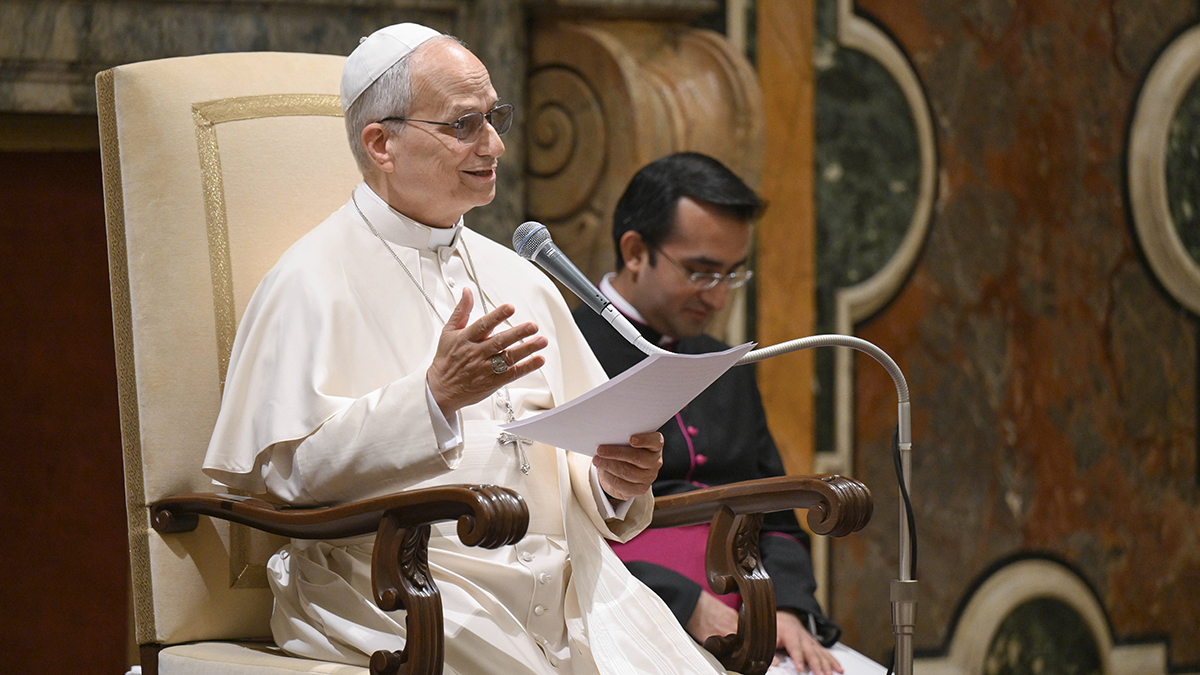
“Always, but especially in the dramatic circumstances of war, such as those we are currently experiencing, the media must guard against the risk of becoming propaganda,” Pope Leo said in an address to broadcast journalists who produce the TG2 news programs for the Italian state-owned television channel, Rai 2.
Pope Leo underlined that the essential and delicate task for journalists is “verifying the news so as not to become a mouthpiece for those in power.”
“It is up to you to show the sufferings that war always brings to the people; to show the face of war and to relate it through the eyes of the victims, so as not to transform it into a videogame,” he added.
Pope Leo acknowledged that “it is not easy in the few minutes of a news broadcast and its in-depth segments,” but underlined that “this is the challenge.”
Reflecting on the challenge of artificial intelligence today, Pope Leo underlined the need to “regulate communication according to the human paradigm and not the technological one.”
People today are living in “an age dominated by polarisation, ideological closed-mindedness and slogans,” he said, adding that makes it more difficult to see and understand “the complexity of reality.”
There is a “temptation,” he added, “to seek out, see and listen only to what confirms our own opinions.”
“But there can be no good communication, nor true freedom and healthy pluralism, without this openness,” he concluded.