


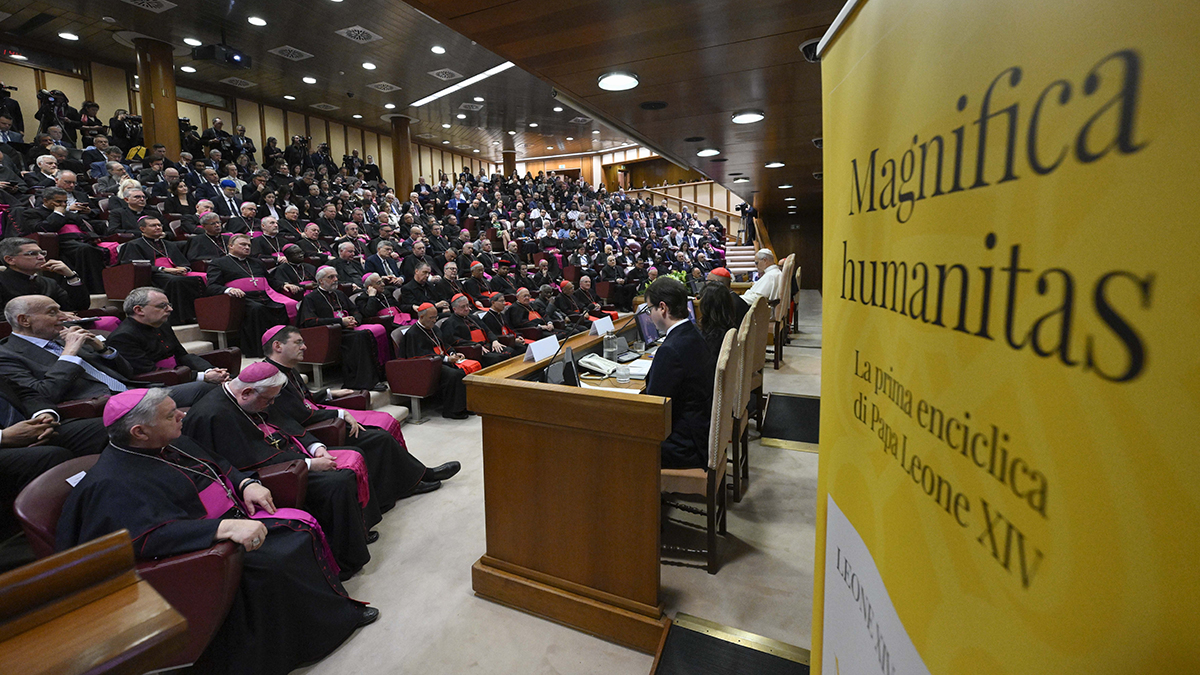
When Pope Leo XIV walked into the Vatican’s Synod Hall on 25 May to present his first encyclical in person, the international press lined up to call Magnifica Humanitas “the AI encyclical.”
The Vatican was at pains to correct them. “Please note that the encyclical is not about AI,” Cardinal Michael Czerny told CBS News at the launch.
“It’s about the human condition during the time of AI.” That distinction is the document’s first instruction to its readers.
Pope Leo signed the text on 15 May, the 135th anniversary of Rerum Novarum. The dating is deliberate. Pope Leo XIII met the Second Industrial Revolution with a defence of the worker.
Pope Leo XIV, a former missionary in Peru and a mathematics graduate, meets what he calls a “change of era” (MH 6) with a defence of the human person as such.
The encyclical describes its own purpose plainly: to safeguard “the human person in the time of artificial intelligence,” and to do so by applying the Social Doctrine of the Church to the res novae of the present moment (MH 4).
The text is structured in five chapters. The first traces the development of the Social Doctrine of the Church from Rerum Novarum to Dilexit Nos. The second sets out its foundations: the dignity of the person, the common good, the universal destination of goods, subsidiarity, solidarity and social justice. The third chapter confronts the technocratic paradigm and the promises of AI. The fourth turns to truth, work and freedom. The fifth addresses what Pope Leo calls a “culture of power” that has rehabilitated war as an instrument of policy. The opening image, repeated throughout, is a choice between two cities: a new Tower of Babel or the rebuilt Jerusalem of the Book of Nehemiah (MH 7 to 10).
Three claims about the encyclical have already begun to circulate. Each is worth correcting at the outset.
The first is that Magnifica Humanitas is hostile to technology. The text says the opposite. Technology, Pope Leo writes, is not “a force antagonistic to humanity”; nor is it “inherently evil” (MH 4, MH 9). What he rejects is the assumption that technical power confers the right to govern.
This is what the Holy Father means by his most quoted phrase, that AI must be “disarmed.” Vatican News editorial director Andrea Tornielli has summarised the move precisely: to disarm means “to break the equivalence between technical power and the right to govern.”
The second is that this is one pope’s personal view of the technology sector. An encyclical is an exercise of the ordinary papal magisterium, addressed in this case to “all the Catholic faithful, to all Christians and to all men and women of goodwill” (MH 16).
Pope Leo states bluntly that papal teaching on shared human governance of AI, on integral ecology, on structures of sin, and on the rejection of war is not a menu of opinions.
It belongs to the same living tradition that produced Rerum Novarum, Quadragesima Anno, Laborem Exercens, Centesimus Annus, Caritas in Veritate, Laudato Si’ and Fratelli Tutti. Pope Leo positions his own text inside that lineage explicitly (MH 28 to 44).
The third is that the document is pessimistic. The dominant register is hope. Pope Leo writes that humanity is “magnificent” even in its woundedness, and that human limits, including illness, ageing and vulnerability, are not defects to be eliminated by upgrades but the very places where relationship, care and openness to God mature (MH 118).
The encyclical closes on the Magnificat: a song of hope sung by a young woman from Nazareth, not a lament for a lost age.
