


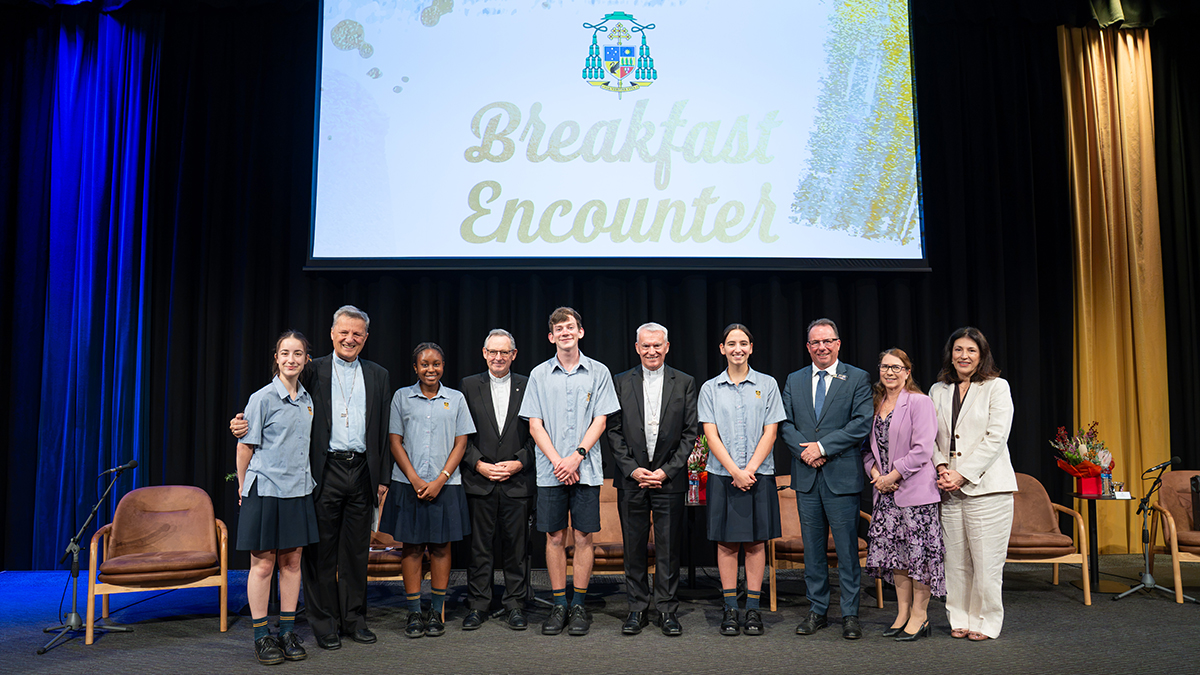
“Only love can make us stay at one table when understanding fails,” Secretary General of the Synod Cardinal Mario Grech has told more than 300 guests at a Breakfast Encounter in Perth.
Representatives from Archdiocesan parishes, offices and agencies gathered at John XXIII College, Mt Claremont, on Tuesday 10 November for an encounter on The Mission We Share: Differentiated Co-responsibility in the Church.
Laura Avery, Director of the Global Centre for Catholic Leaders at the University of Notre Dame Australia, served as MC in addition to students from John XXIII College who led the opening prayer session.
The Encounter has taken place during what is the Synod’s implementation phase, as local Churches put its conclusions into practice ahead of an ecclesial assembly at the Vatican in October 2028.
The Maltese born Cardinal Grech began by greeting Perth Archbishop Timothy Costelloe SDB as a close friend and collaborator, thanking him for the invitation and recalling that he had felt at home on arriving in Perth.
“It is good that we listen to others, but in a synodal church, the aim is not only to listen to one another, but to listen to one another in order that we can listen to the Holy Spirit.”
Every synodal setting, including a parish council, constituted a liturgy because people gathered to listen to the Spirit, he explained.
Cardinal Grech recalled a story about students who bought their teacher a silver pen.
The teacher thanked them but said he would have preferred blue cheese.
“We work for God, and yet we do not do God’s will, and this is very serious,” Cardinal Grech said.
Charles Péguy’s The Portal of the Mystery of Hope provided the starting point for his reflection on love, faith and hope in the Church’s life.
“Love is not an emotion we feel for the church, but the way we inhabit the church.”
He spoke of a synodal Church that recognised different vocations, charisms and ministries, and of love as an active commitment to communion when conversations proved difficult.
“Love is the decision to remain present.”
He distinguished unity from uniformity, speaking of communion through mutual respect and shared purpose. Love required tenderness towards people who felt unheard, excluded or wounded, and trust that the Holy Spirit worked even amid disagreement.
Faith, he explained, recognises God’s presence within the Church’s human reality without ignoring its imperfections.
He called for listening to all the People of God, including the poor and marginalised, and to tradition’s wisdom.
Hope concerned the future, which belonged to God. Cardinal Grech grounded hope in Jesus Christ and God’s promises, linking it with humility and freedom in the Church’s work.
“Hope teaches us to work without possessing what we build,” he said.
“We hope, not because we can foresee the outcome, but because we have met the one who holds the future.”
He said Pope Francis and Pope Leo XIV identified synodality as the Church’s way forward.
He applied those reflections to the reception and implementation of the Synod, stressing that each local Church needed to respond within its circumstances.
“Each diocese has its own characteristics, its own talents, its own context, and in that context, the Lord wants to be present.”
He linked the Church’s future with implementing the Synod’s final document and closed by returning to Péguy’s understanding of hope.


Irish priest Fr Eamonn Conway, Professor of Integral Human Development at the University of Notre Dame Australia, led the panel session.
He explained that “prayer isn’t just something that happens at the beginning and end of a meeting, but the whole entire gathering can be prayerful”.
He set aside prepared questions and invited participants to identify the good news they had heard.
Archbishop Costelloe pointed to the students’ welcome and prayer, and the gathering itself, as good news.
He described “this extraordinary reality, which is our Archdiocese, with all its strengths, but also all its fragilities”.
Catholic schools help young people understand the Gospel, Archbishop Costelloe said.
Catholic Education Western Australia Executive Director Annette Morey connected hope and co-responsibility with schools supporting one another across the State’s four dioceses.
“We’re not doing it alone. A lot of our schools couldn’t survive alone, particularly some of our very small and regional and remote schools.”
John XXIII College Principal Daniel Mahon spoke of students’ lived experience, listening with the ear of the heart and discernment that went beyond weighing advantages and disadvantages.
Linda Brandon from Subiaco Parish said “synodality, while a new word, is not a new concept.”
“It’s already pervasive through our church and parish life.”
She likened it to a golden thread through parish life, saying that naming it helped people recognise and appreciate what already existed.
Ms Morey highlighted Catholic education partnerships between city schools and regional and remote schools, and the importance of responding to the needs of each community.
“Listening to the people and listening to the needs of those communities is really paramount.”
Mr Mahon spoke about a school’s culture of welcome and the responsibility to challenge behaviour that fell short of it.
“A welcome is more than just that warmth.”
“It’s opening the heart, and I think part of reminding a community about the importance of that is to be brave enough to recognise when it’s not happening and challenge it.”

Cardinal Grech closed the panel by describing the gathering as an encounter with the Church.
“The church is not the building, the structure, but the people of God, together with their pastor.”
He emphasised the relationship between bishops and their people, saying bishops needed to learn to listen because, through their people, they also listened to the Holy Spirit.
He encouraged the community to walk together and described its mission as giving “flavour to the life of your country”.