


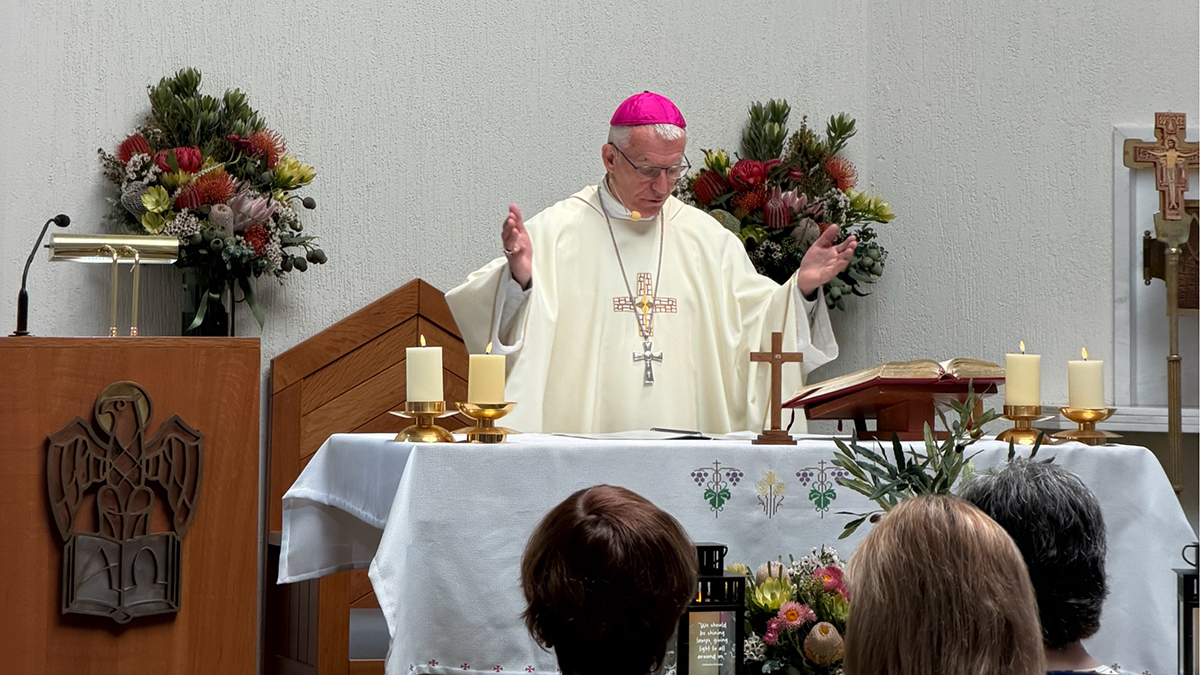
“Because we are disciples of Jesus, called to walk in his ways, it follows that we, too, through our communion with him, are called and challenged to allow mercy to become living and visible in us,” Perth Archbishop Timothy Costelloe SDB told the congregation at Mercy Village in Wembley during a Mass on Tuesday 22 September.
The Mass at Mercy Village marked 180 years since the Sisters of Mercy arrived in Western Australia. Ursula Frayne led the first sisters ashore at Fremantle on 8 January 1846.
Archbishop Costelloe opened his homily by recalling the 2016 Year of Mercy, when Pope Francis invited the faithful to focus on “a simple but profound message which shines through every word of the Gospels: Jesus Christ is the face of the Father’s mercy”.
“Another word for mercy, as it is understood in the Christian tradition, is large-heartedness,” he said.
He often encouraged young people during the Year of Mercy to be large-hearted people.
“I would like to say the same to all of you gathered here this morning,” he said.
Archbishop Costelloe described mercy as “the driving force in the life of Catherine McAuley”, whose House of Mercy on Baggot Street in Dublin opened on 24 September 1827, the Feast of Our Lady of Mercy.
He looked ahead to the bicentenary in 2027, which he said will be “an even bigger year for the Mercy family”.
“Before all else, of course, Catherine McAuley was a disciple of Jesus,” he said.
Archbishop Costelloe pointed to Saint Paul’s words to the Christian community at Philippi, “you must have in you the same mind that was in Christ Jesus”, and named constant reading and meditation on the Scriptures, particularly the Gospels, as “certainly the only way to ensure that we do not lose our way”.

In the day’s Gospel, from Matthew 25, Jesus speaks of the hungry, the thirsty, the strangers, the naked, the sick and those in prison.
“There is no judgment, there is no condemnation, there is simply the recognition of a need crying out to be met,” Archbishop Costelloe said.
Those in the parable who showed mercy did not always recognise Christ in the people they served, he said.
“What matters is that people in need were seen, recognised and cared for.”
Archbishop Costelloe acknowledged that “ideals are one thing while the realising of those ideals is another”.
He said the presence of Christ within “will enable us to realise those hopes, when we might otherwise, through tiredness or self-centredness, give up the effort and turn in on ourselves”.
He said the mission of MercyCare is to build on the legacy of those 180 years and remind the whole Catholic community, “and indeed the community beyond”, of the need to be “signs and bearers of the merciful love of God, made real and present in Jesus Christ”.
“Let us all commit ourselves this morning to be large-hearted people, part of a large-hearted ministry in the Church, the ministry of MercyCare,” Archbishop Costelloe said.