


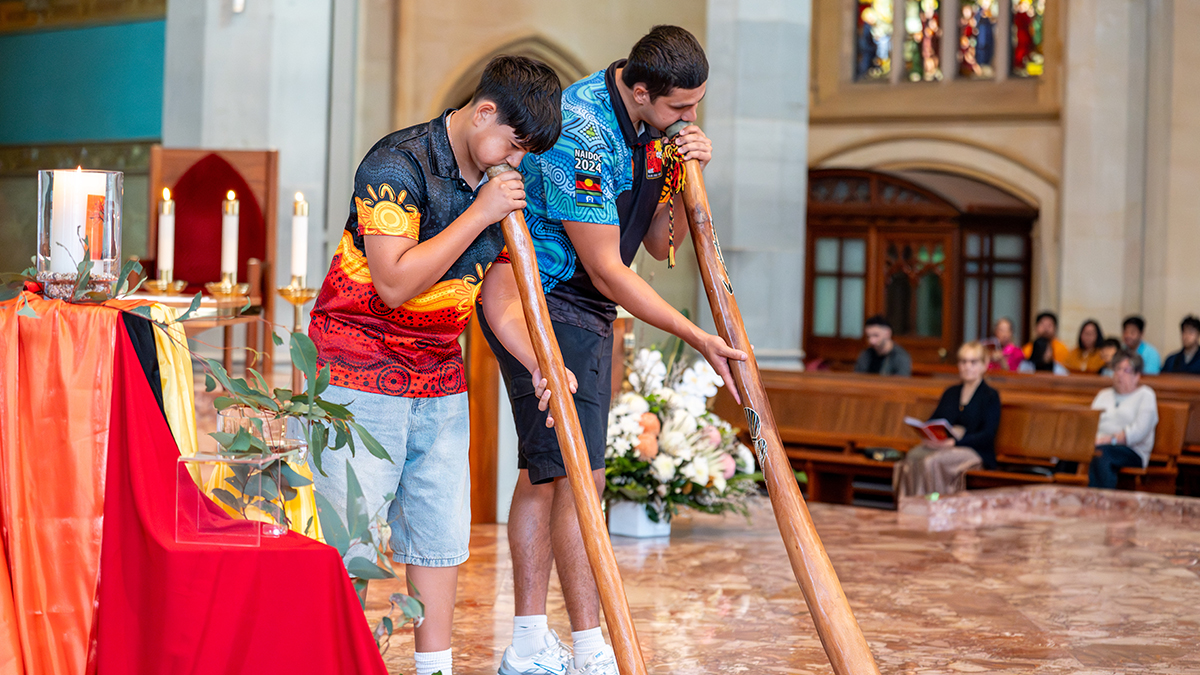
“Into every culture that God has entered, people have received a call,” Perth Auxiliary Bishop Don Sproxton told the congregation at the annual Aboriginal Sunday Mass at St Mary’s Cathedral on Sunday 18 October.

Prior to the commencement of Mass, guests were welcomed with a traditional smoking ceremony and Welcome to Country by local Whadjak Noongar elder Robyn Collard, in additional to the playing of the didgeridoo by her grandsons.
Concelebrating the Mass with Bishop Sproxton was former Embleton Parish Priest Fr Patrick Toohey and Cathedral Assistant Fr Jason Yeap.

Bishop Sproxton also carried the Sprinkling Rite using branches from a Eucalyptus.
Typically celebrated on the first Sunday of July, Aboriginal and Torres Strait Islander Sunday is a time when the whole church comes together to celebrate and acknowledge the gifts of Australia’s First Peoples.
Speaking about the 40th anniversary of Saint John Paul II’s address to Aboriginal and Torres Strait Islander people at Blatherskite Park, Alice Springs, on 29 November 1986, Bishop Sproxton recalled the Pope’s tribute to newcomers who tried to understand and learn from Aboriginal people amid the dispossession of their lands.
“They loved and cared for the indigenous people. They began to share their stories of God, helped you cope with sickness, tried to protect you from ill treatment,” St John Paul II said.
Bishop Sproxton also spoke about Perth Bishop Rosendo Salvado and the Benedictines of New Norcia, who protected Aboriginal families, and the St John of God Sisters, who gave medical care in the Kimberley, Perth and Kalgoorlie.
He also told the story of Ellen Bussell, who farmed with her husband in the South West, close to coastal sand hills where archaeologists believe Aboriginal groups camped each summer.
“Ellen won the trust of these people and so was able to teach them what they would need to cope with their changing world,” Bishop Sproxton explained.
Saint John Paul II acknowledged many mistakes and a clash of cultures, Bishop Sproxton said, yet spoke with gratitude of people like Ellen: “Nothing can ever minimise the depth of charity.”

Christ’s word of call resonated in the hearts of Australia’s first peoples, he said. They had come to know the Spirit through the land and all the creatures that shared their existence, and those who spoke of Jesus revealed that Spirit as the Holy Spirit.
“In this way they already had some knowledge of this great Spirit,” he said. “And the story of Jesus completed this knowledge of God.”
He quoted the address: “The Gospel of our Lord Jesus Christ speaks all languages. It esteems and embraces all cultures.”
The Australian Catholic Bishops Conference (ACBC) sets aside the first Sunday of July as Aboriginal and Torres Strait Islander Sunday, and the National Aboriginal and Torres Strait Islander Catholic Council chose Walking Together in Christ: 40 Years on! as its 2026 theme.
In September, the ACBC Bishops Commission for Relations with Aboriginal and Torres Strait Islander Peoples urged parishes and schools to mark the anniversary, noting that the address inspired many dioceses to begin Aboriginal Catholic ministries.
The Archdiocese of Perth has produced a commemorative edition of the address, with an introduction from Bishop Sproxton and artwork by Acacia Collard and Kevin Bynder.
“By becoming sons and daughters of God, may we work to build pathways for Reconciliation and forgiveness,” Bishop Sproxton said. “May we live fully human and Christian lives.”
He closed with the prophet’s words that Saint John Paul II also spoke at Alice Springs: “Do not be afraid for I have redeemed you; I have called you by name, you are mine.”


According to the 2016 census, Western Australia is home to nearly 20,000 Indigenous Catholics. The highest percentage of Catholics is in Broome where Aboriginal and Torres Strait Islanders make up 61 per cent of all Catholics. Geraldton comes in second where 13 per cent of Catholics are Aboriginal or Torres Strait Islander.