


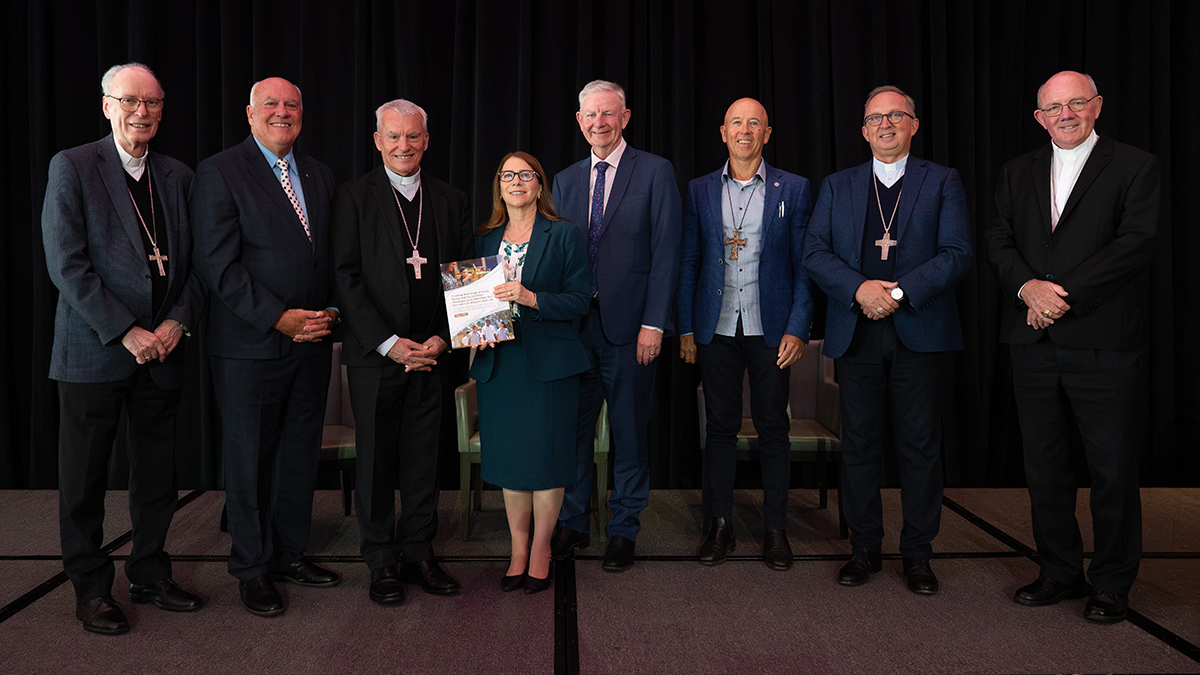
“Our aim has been to produce a document which speaks to the reality – the challenges and opportunities – of our present situation,” Perth Archbishop Timothy Costelloe SDB has said.
Speaking at the launch of the new Bishops’ Mandate for Catholic Education in Western Australia 2027–2033, Archbishop Costelloe continued by saying that as Christians in the Catholic tradition we acknowledge and engage with the challenges and opportunities of our time in the light of the gospel of Jesus Christ.
“And the way the Spirit has guided and continues to guide the Church as we seek to live in fidelity to that gospel.”

Titled Charting New Maps of Hope, Peace and Joy in Christ: Shaping Future Directions for Catholic Education in Western Australia, the new Mandate launch brought together more than 350 principals and representatives from Catholic schools across Western Australia, including Perth Auxiliary Bishop Don Sproxton, Broome Bishop Tim Norton SVD, Geraldton Bishop Michael Morrissey and Bunbury Bishop George Kolodziej SDS.
They were joined by Catholic Education Commission of Western Australia Chair, Tim Shanahan, CEWA Executive Director Annette Morey, Deputy Executive Director Julie Hornby, former CEWA Executive Director Wayne Bull AM and numerous other CEWA leaders.

Ms Morey opened the forum with the question: “What happens when a system stands at the crossroads; grateful for the road that has brought us here, but called by faith, service and mission, to choose the path that will carry us into the future?”
“It is not simply a document to be received, placed on a bookshelf or referenced when required. It is an invitation. It is a call to renewal,” she added.
“What has helped us get to where we are as a Catholic education system today, may not necessarily be what will drive us to success in the future.”

Mr Bull, commissioned by the bishops last September, spent 12 months consulting bishops, principals, teachers, parents and student representative councils to develop the new Mandate.
He handed the credit straight back to the principals and teachers gathered for the launch.
“The document that sits in front of you today is really one that has been developed by you,” he said.

“We’re so blessed that in Western Australia, people are really presented with one united voice from the now six bishops of Western Australia,” he added.
Referring to the previous Mandate that was produced in 2007 and 2008, Mr Bull said it has served us well.
“But it is time for us to be looking at some new directions,” he said.
The new Mandate contains 281 numbered paragraphs, focussed across the five pillars of Catholic Identity, Education, Community, Stewardship and Governance
Around 170 endnotes are hyperlinked in the digital version.
“It’s not really designed to be read in a single sitting,” Mr Bull said. “It’s designed to be a reference that you can go to.”

Archbishop Costelloe spoke to the matter of Catholic Identity and summarised it in four words: fidelity to Jesus Christ.
Bringing the attention of those present to paragraphs 24 to 28, which look at the Mission of a Catholic School in the Contemporary World, Archbishop Costelloe asked those present “what in the end will be both a challenging and a very practical question, especially for the majority of you who are engaged very directly in the life of a particular school.
“How can we, in our local situation, hold together in creative tension, the call of Jesus found at the end of Matthew‘s gospel to proclaim the good news to everyone, baptising them in the name of the Father and of the Son and of the Holy Spirit, with the Church’s insistence that the religious freedom and personal conscience of individual students and their families must be respected?”

“I would make two suggestions in this regard, which may be helpful,” Archbishop Costelloe continued.
“The first comes from Pope Benedict and was repeated by Pope Francis: it is the responsibility of the Church – and again therefore, in parentheses, the responsibility of Catholic Education – to propose endlessly but never impose.”
Broome Bishop Norton spoke about community and told stories rather than walking through the text. Describing the Mass at a former leprosarium outside Derby, Bishop Norton recalled how 250 people gathered for the liturgy and for truth-telling from four people once interned there.
The local Catholic school hosted lunch afterwards, and every teacher came to serve.
“The whole Catholic school community has responsibility for implementing mission, not just the leaders,” Bishop Norton said, citing paragraph 108.
Bunbury Bishop Kolodziej focussed on education and made his point directly.

“We are not running an ATAR factory with a chapel attached,” he said.
“Catholic education is not simply about producing successful students; it is about forming flourishing human persons in Christ.”
On artificial intelligence he drew the line at human encounter. “AI may draft the newsletter. It cannot notice the child sitting alone at lunchtime.”
Speaking about stewardship, Geraldton Bishop Morrissey’s focus looked to an experience at St Cecilia’s in Port Hedland which was founded in 1942 when Aboriginal children were barred from attending school beyond year three. He returned repeatedly to paragraph 167, emphasising that losing the poor is losing the school.

Closing the forum, CEWA Commission Chair Tim Shanahan highlighted the Mandate is not a preservation tool.
“It’s really a tool to help us change, to help us improve,” he said. “We need to be courageous, and we need to be future-focused. We need to remain anchored in what makes Catholic education Catholic.” He finished by speaking about ownership. “This isn’t our project. This is God’s mission, and we’ve been invited to participate and in our own way to lead that mission.”