


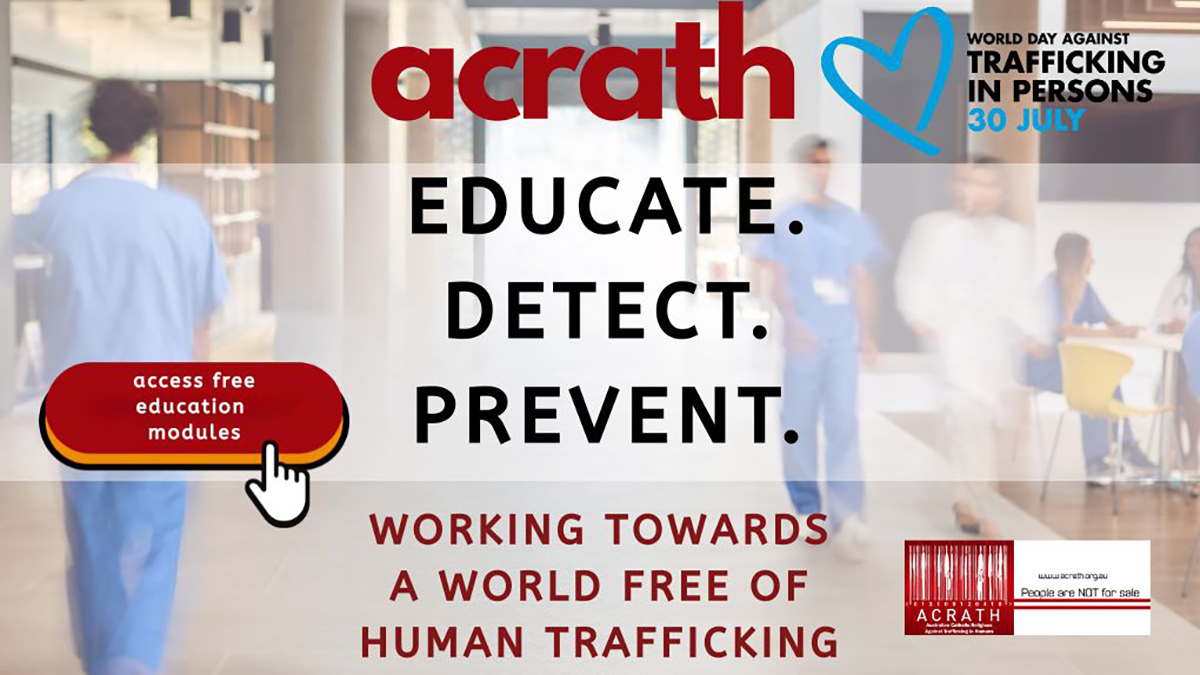
Modern slavery in Australia remains hidden in plain sight and often overlaps with family violence, homelessness, substance dependence, mental illness, or disability, ACRATH (Australian Catholic Religious Against Trafficking in Humans) has said.
In an attempt to recognise, address and prevent this crime, ACRATH has used the World Day Against Trafficking in Persons on the 30 July to promote the range of free online healthcare screening tools and professional development modules that are available to healthcare professionals who are uniquely positioned to identify, respond to, and refer victims of modern slavery to specialist support.
The Building Clinician Confidence series of on-demand modules were co-designed with survivors of modern slavery, St Vincent’s Health Australia, the NSW Anti-slavery Commissioner and the University of Notre Dame Australia, with support from the Australian Government’s Attorney-General’s Department.
The free modules feature filmed simulations of real case studies, guiding clinicians in trauma-informed care responses.
They are suitable for nurses, doctors, social workers, psychologists, pastoral carers, speech pathologists, pharmacists, dietitians, peer support workers, occupational therapists, physiotherapists, and managers.
Emergency department staff are a vital safety net as research shows most trafficking victims engage with healthcare during exploitation. Recognising warning signs is essential for connecting victims to critical support.
“These modules, along with the Educating for Change modules aimed at university students across various disciplines, offer a great opportunity to build awareness of modern slavery among professionals,” Executive Officer of ACRATH, Sarah Puls said.
“There is so much more work to be done, but every new participant means more support for victim/survivors.”
“ACRATH’s contribution directly translates to improving the recognition of modern slavery survivors, which is the biggest challenge facing the anti-slavery sector,” added Modern Slavery Liaison Officer at St Vincent’s Health Australia, Tarang Jain.
In 2026, clinicians were instrumental in the conviction of a Melbourne man found guilty of possessing a woman as a slave.
At the time, Australian Anti-Slavery Commissioner, Chris Evans stated: “This confirms modern slavery is not only a Commonwealth criminal justice issue – it is a public health issue that requires greater engagement with the states. Healthcare and other frontline workers are uniquely placed to identify and support victim-survivors.”
According to statistics published by ACRATH, some 50 million people live in slavery globally, 71 per cent of which are female. Only one in five victims are detected in Australia.
Earlier this year, Attorney-General, the Hon Michelle Rowland MP announced the federal government would be strengthening Australia’s modern slavery laws and equipping companies to better identify and address risks in their global supply chains.
“Modern slavery is a major violation of human rights and has devastating impacts, depriving victims of their basic freedoms and dignity,” the announcement stated.
“Modern slavery – which includes slavery, forced labour and debt bondage – is a crime under Australian law, including where it happens outside Australia.”
The free Building Clinician Confidence modules can be accessed here: https://acrath.org.au/resources/healthcare-education/
