


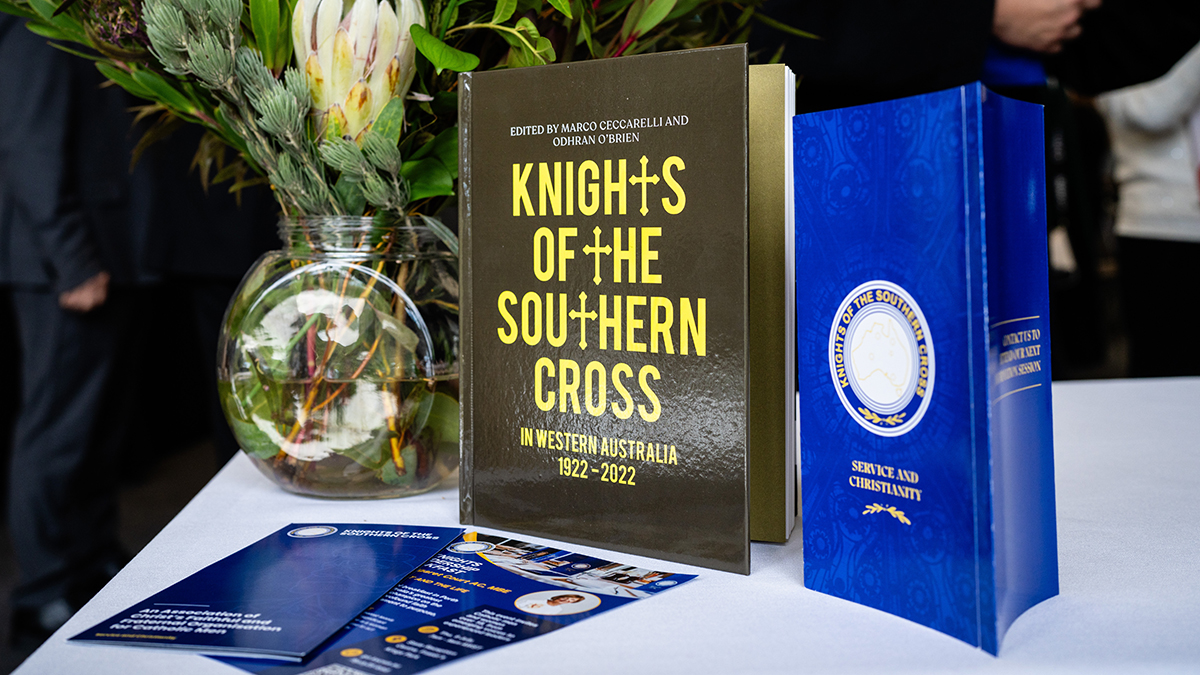
Centenary books can sometimes feel dutiful. However, the recent Knights of the Southern Cross in Western Australia 1922-2022 is a serious work of history and a revealing account of how Catholic laymen helped shape the life of the Church and, in important ways, the social fabric of this State.
Edited by the Archdiocese of Perth’s Centre for Faith Enrichment Director, Dr Marco Ceccarelli and Director of the Archives and Information Governance Office, Odhran O’Brien, the story is wisely told through nine contributors.
That approach suits the subject because the Knights themselves appear here not as a single storyline but as a century of changing responsibilities: defending Catholics from sectarian prejudice in the 1920s, supporting wartime welfare, campaigning for educational justice, helping build aged care, and backing faith formation, bioethics, safeguarding and leadership in later decades.
What gives the book authority is that it begins where it should, not with self-congratulation, but with the hard pressures that made the Order seem necessary.
Jeff Kildea’s opening chapter on sectarianism, Freemasonry and lay leadership is essential reading because it explains the climate of anti-Catholic suspicion and employment disadvantage that lay behind Archbishop Patrick Clune’s invitation to establish the Order in Western Australia in 1922.
The next strength is its refusal to leave history abstract. Robert Andrews and Kildea bring the first Knights into focus through biographies of James Patrick Maxwell, Daniel Mulcahy, Thomas Ahern, Patrick Francis Quinlan and others.
These are not token name-checks. They show that the early Knights were networked, capable laymen with legal, commercial and civic influence, and that fact matters if readers are to understand how the movement actually worked.
I was especially taken by the middle of the book, where the broad narrative becomes tangible in concrete works and contested episodes.
The chapters on the Catholic Immigration Reception Committee, St Mary’s Agricultural School at Tardun, the Bushies Scheme, wartime homefront relief and the Catholic Welfare Organisation show an Order trying to convert fraternity into service.
Just as importantly, the book does not hide failure or friction. Financial strain, disputed projects, internal splits and the later national financial crisis are part of the story too. That honesty makes the achievements more convincing, not less.
One of the book’s great virtues is that it tracks change without pretending the world stood still.
Josephine Laffin’s chapter on Vatican II and the ‘new look’ Order is especially good on the slow move from secrecy to a more public form of Catholic witness.
Angela McCarthy and Clement Mulcahy then show how the Knights turned toward aged care, education, overseas aid, Indigenous engagement, employment pathways, bioethics and support for institutions that many Western Australian Catholics know firsthand, including Southern Cross Homes, Southern Cross Care, the KSC Education Foundation and later the Knights Catholic Leadership Academy.
Nigel Hayward’s closing chapter also strengthens the book because it refuses an easy, sentimental ending.
Instead, it asks what happens to an organisation like this when membership falls, society changes and the old certainties no longer hold. That gives the final section real force. The centenary is treated not as a museum piece but as a point of discernment. That makes the book feel alive.
What impressed me most, though, was the scale of the research. This volume draws on State Council minutes, Advance Australia and Knightlife, archival collections, digitised records and oral histories, and it is strengthened by appendices, bibliography and images that make it useful not only for present readers but for future historians.

Perth Archbishop Timothy Costelloe SDB is right in the foreword to call it more than a centenary book. It is also a social history of Catholic lay action in Western Australia.
This is a book for Knights and their families, certainly, but it deserves a wider readership than that.
Anyone interested in Western Australian history, Catholic education, lay leadership, or the hidden architecture of community service will find substance here. It is scholarly without becoming cold, proud of its subject without becoming evasive, and local in the best sense, deeply grounded in the people, parishes and institutions of this State.
For readers of The Record, it offers something rare and valuable: a century of Catholic memory handled with seriousness, gratitude and clear historical discipline.
Copies of the Knights of the Southern Cross in Western Australia 1922–2022 are now available at: https://go.kscwa.au/100yearhistorybook
Source note
Primary source: Marco Ceccarelli and Odhran O’Brien, eds., Knights of the Southern Cross in Western Australia 1922-2022 (Crawley, WA: UWA Publishing, 2024). All factual references in the review above are drawn from the attached volume, especially its foreword, introduction, chapter sequence, acknowledgements and appendices.