


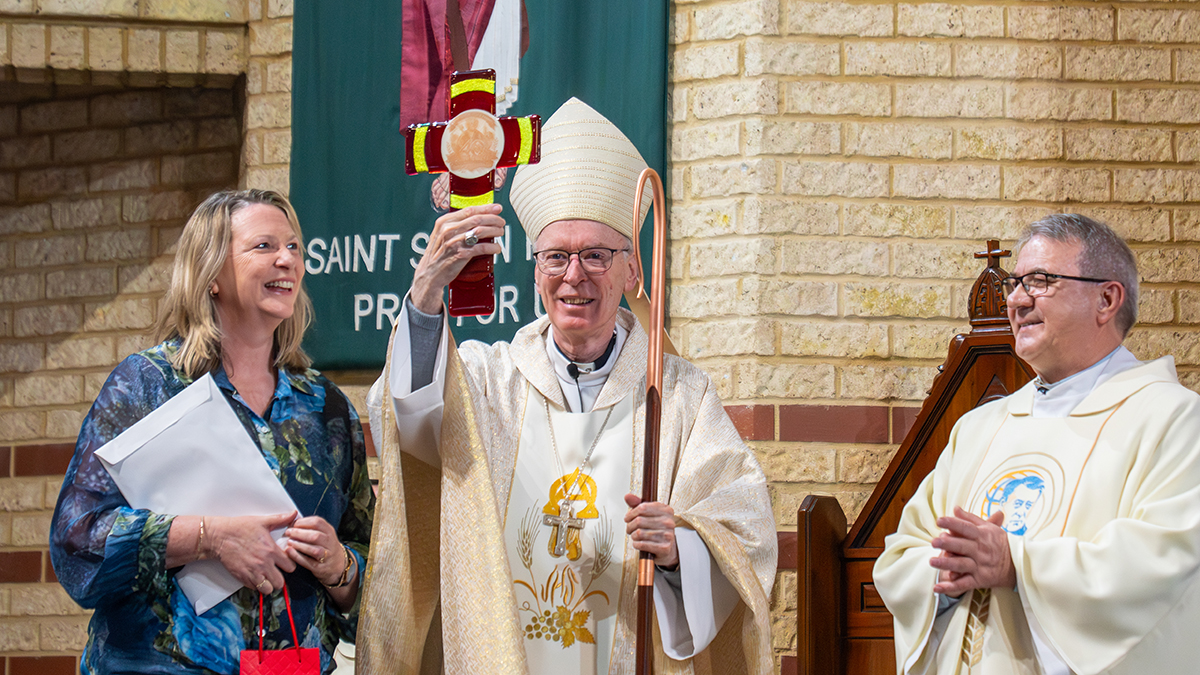
A beautiful sign of the presence of the Lord was given to us at the very beginning when we use the incense to incense the sacred altar, and to, in a way, remind ourselves also of the cross and have the place of the cross in our life, and how that can be a sanctifying thing as well.
It made me remember Father Simon, because, as you know he didn’t like to preach too long, he liked the ceremony of the Mass to be reverent, though it was rapid, and mainly because he wanted to go and have a cigarette. That was the way I think that he was able to get through things, but anyway, the celebration today began very beautifully, and I’m very grateful for your presence here.
In a way, the feast that we celebrate today, Trinity Sunday, brings together the three great festivals that we have been celebrating.
Of course, the resurrection of Jesus at Easter, which in a way is how we come to know God the Father as the life giving one.
Then, at the ascension, we celebrated the leading of Christ from the presence of the apostles but also assuring them at the same time that He would be with them until the end of time. But it was the ascension of Jesus who had been vindicated and has now become the exalted one, because He sits at the right hand of Father.
And then, in Pentecost, we celebrate the gift of the Holy Spirit on the Church when the Holy Spirit descended upon that first group of disciples, and we could see by those amazing things that happen immediately afterwards, that the Spirit is the empowering one.
So, in a way, in celebrating this Trinity Sunday, we are celebrating and bringing together these three great feasts of the Church.
I mentioned at the beginning of the Mass that we give thanks every time we celebrate the Mass for the gift of the Spirit, the Holy Spirit that enables us to celebrate the Mass in the first place. You will notice, at the time of the consecration, during the Eucharistic prayer, the priests and I will be laying our hands, in a sense, over the bread and the wine, and that will be a moment, a very important moment in our liturgy, because the Holy Spirit will come upon those gifts and enable them to be made into the body and blood of Christ for us.
So, the gift of the Spirit for this community, I believe, was experienced right from the very beginning in those first days when the parish was founded. The community obviously didn’t gather in the church, but it gathered possibly in several places before finally the church was built, and it was in that journey towards coming into the house of the Lord here in this church that they experienced the Spirit doing extraordinary things to them as well.
It was only really a very short time after the parish was founded that you, in fact, achieved this extraordinary thing of building this church. Extraordinary things happened for you, magnificent things, all because of the Spirit being present to you and empowering you.
The readings of the Mass today in each case highlight what I have just said about the drawing together of these feasts.
The first reading was really about the journey of Israel, the ups and downs, the moments of glory when they accepted the law that was given to them, the Torah, but there were many times as well where they failed. They failed because they forgot about that commitment that had been made for them to follow the Lord and follow the law that had been given.
However, what is even more important than that story that we had in the first reading was the story at the very beginning when God created everything, when God created humanity, and it was in that moment that God really indicated the importance of each and every one of us to be made in the image and the likeness of God.
It was Jesus Christ who we recognise as being the perfect image of God. What the people of Israel at times forgot was it’s not so important that they have a temple, or so important that they would have these special places of gathering, or that even they would have their festivals. What was important was to know who God is, and to know how God acts.
Jesus has helped us, I think, to understand who God is. After all, He has revealed to us that God is Father, Son, and Holy Spirit. He’s also revealed to us that where we achieve happiness in our lives, and that is enjoying the presence of God in our life, it will be through obedience which is listening to the word of God, listening to what Jesus has taught, and understanding how we too can become true images of God in our own lives.
They say that at Pentecost, when the disciples and the apostles received the Holy Spirit, they performed extraordinary signs of the power of the Spirit immediately. That ushered in for a period of time many extraordinary things, many extraordinary miracles, but they say the greatest miracle is how there’s a moral miracle in the Church.
The moral miracle is the gathering of people of different nations of different languages to form Christian communities, and that really is the greatest miracle that we see. We see among us here many people who have come from so many different countries, so many different Catholic cultures, and yet we are one. This is the miracle, the great miracle that we can observe for ourselves, because of the Spirit at work within this community.
So, in the time of those extraordinary signs past, that even greater sign, that very consoling sign to us is that we can be a Church, we can be a community that is at one – has one mission, has one objective, so in that way we resemble very closely our God, who is Trinity, who is a community of persons.
So, as we continue in our celebration today, there’s much to remember, there’s much to give thanks for in our celebration, especially that experience that we may have had of the Spirit at work among us, bringing that unity and bringing together that mission that we engage in as a Christian community in this part of the archdiocese, and how we have come to know God and we have come to know His ways.
Finally, I’ll finish with an article from The West Australian that I read, and it’s from that column that Justin Langer writes, and he was reflecting on the life of Neil Daniher. One of the things he mentioned in that article, and it’s typical of Justin, he remembers going to Mass at St Joseph’s in Subiaco and very often he would seal see Neil Daniher there in the congregation, also at Mass, also at prayer, but what impressed him was his humility, and that faith to live through what he did live through in the end, a dreadful disease that took him eventually, but never losing hope and never losing his faith in God, who he knew so well.
So it could be a very good example to us, I’m sure, of one who has been touched by the Spirit, has been strengthened and empowered by the Spirit, and has, for the rest of us, given us a sign of what it means to be the image of God to be that one who is able to live with faith each day of hardship.
There are many stories I’m sure that you have to share from the experiences that you’ve had of one another. We give thanks for that sign that we might have given to others of our faith that has strengthened their faith and help them on their journey.


+Bishop Donald Sproxton, Auxiliary Bishop of Perth