


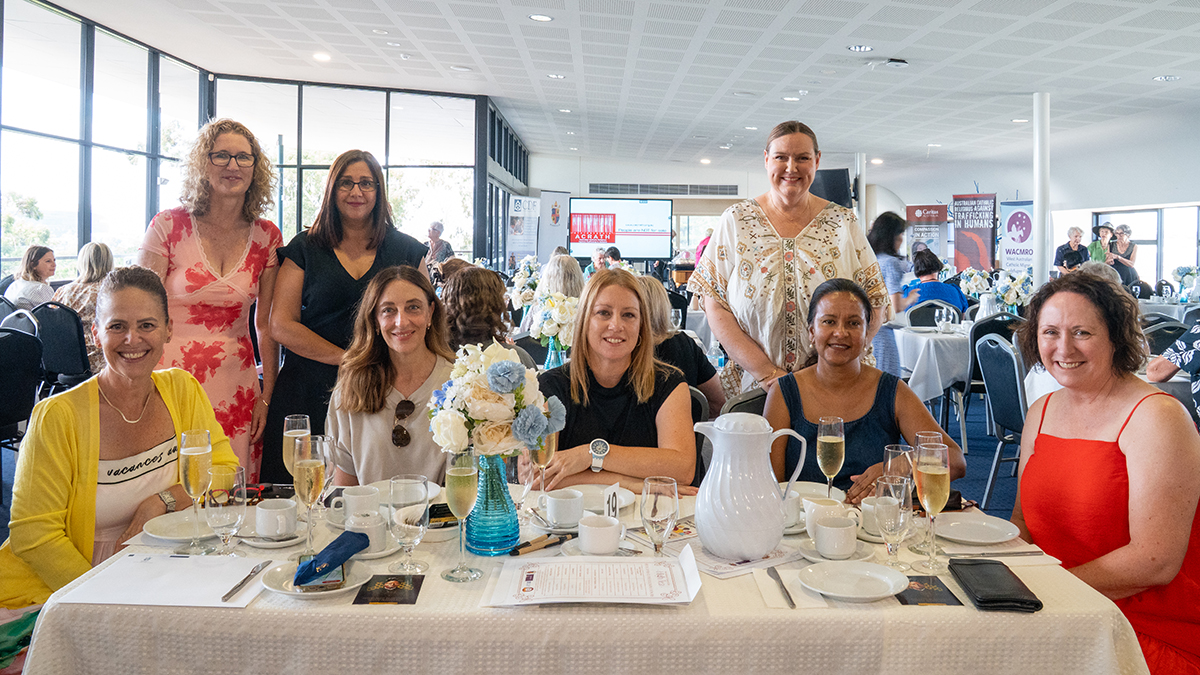
Catholic and community leaders, educators and advocates gathered at Trinity College on 8 March to mark International Women’s Day with a high tea focused on raising awareness of modern slavery and human trafficking.
Hosted by the WA Modern Slavery Network, the event brought together people committed to addressing exploitation in all its forms. The afternoon was co-hosted by the Archdiocese of Perth and ACRATH WA (Australian Catholic Religious Against Trafficking in Humans), with sponsorship from the Catholic Development Fund.
The gathering began with a Welcome to Country by Director of Aboriginal Catholic Ministry, Donella Brown, who spoke about the deep stories held within the land of East Perth and the journeys of Aboriginal women and families connected to the area.
“As stories are shared, they are woven into the fabric of this land,” she said.
Among those attending were Vicar General, the Very Rev Fr Vincent Glynn; Member for the Central Wheatbelt and Shadow Minister for Agriculture and Food, Racing and Gaming, Mr Lachlan Hunter MLA Catholic Education Western Australia Ltd, Executive Director, Mrs Annette Morey; University of Notre Dame Australia, Pro Vice-Chancellor Student Experience, Professor Selma Alliex and Ms Melanie Dunn, representing Trinity College.
Gemma Wooltorton, WA Coordinator of ACRATH, led the Prayer for Victims of Modern Slavery and Human Trafficking. She reminded attendees that modern slavery remains a growing concern.
“Statistics from the Australian Federal Police show that cases of modern slavery and human trafficking have increased in Australia in recent years,” she said.

Maureen Delaney, a member of WA ACRATH, then introduced keynote speaker Dr Carol Kaplanian, who is an internationally recognised expert in honour-based violence, family and domestic violence and forced marriage.
Dr Kaplanian has extensive experience working with government agencies, police, refugee communities and victim-survivors of violence. She has spent many years supporting women both in Australia and overseas.
During her address, Dr Kaplanian shared elements of her own family history in dedication to her mother who was also present at the event.
Born in Jordan to refugee parents, Dr Kaplanian spoke about the legacy of displacement and resilience within her family.
Her grandfather survived the Armenian genocide as a child, while her mother was born in Jerusalem during the upheaval surrounding the 1948 war before the family was forced to flee to Jordan.
“My parents sacrificed their dreams and opportunities so that we could have a future,” she said.
Those sacrifices, she explained, enabled her to pursue higher education and a career advocating for vulnerable women and girls.

She described how her commitment to this work began during a placement in a refugee camp on the Jordan–Iraq border. What was meant to be a three-month placement became an eight-month experience where she helped distribute aid and provide basic education for children.
Girls in the camp were permitted to attend school only one day a week, while boys were given priority for the remaining days.
Determined to create change, Dr Kaplanian worked with volunteers to build a simple classroom using salvaged materials from nearby war-damaged buildings. With support from donors in Australia, backpacks, books and learning materials soon arrived.

“Those girls were suddenly able to attend school five days a week,” she said. “It became something they were proud of.”
But it was the relationships she built with women in the camp that ultimately shaped her life’s work.
Over time, mothers confided in her that their daughters had been killed, often following sexual assault or after refusing forced marriages.
Their stories of grief and trauma left a profound impact. “That was the moment I realised what my purpose was,” Dr Kaplanian said.
She reminded attendees that exploitation and forced marriage are not only issues overseas but can occur within Australian communities.
To illustrate this, she invited the audience to imagine a teenage girl preparing to leave home, knowing she is about to be forced into a marriage she did not choose.
“Imagine if instead of stepping into a ceremony that sealed her silence, she stepped into a classroom that protected her future, a law that defended her rights and a community that stood beside her,” Dr Kaplanian said.
Citing global data, she explained that tens of millions of people worldwide live in modern slavery, including millions of women and girls forced into marriage or labour exploitation.
“International Women’s Day is often festive,” she said. “But it must also be fearless.”
She encouraged communities to take practical steps to support those at risk – from teachers noticing unexplained absences to frontline workers offering safe avenues for help.
“Our commitment begins by naming the problem, resourcing solutions, educating communities and believing survivors,” she said.
Dr Kaplanian concluded by reminding attendees that achieving justice requires courage and collective responsibility.
“Let us be the generation that places education, law, support and courage on the scales until justice outweighs exploitation,” she said. “A world where marriage is always a choice and no woman’s freedom can ever be bought, sold or stolen.”
Responding to the keynote, Executive Director of Catholic Education Western Australia, Mrs Annette Morey, reflected on the responsibility of Catholic communities to stand against exploitation.

Drawing on Catholic Social Teaching, Mrs Morey said every person is created in the image of God and society is called to stand in solidarity with those who suffer.
“Pope Francis has described human trafficking as an open wound on the body of contemporary society,” she said, adding that the Church must be a beacon of hope and action in ending modern slavery.
“Dr Kaplanian has also inspired us to reflect on what more we can do in Catholic education,” Mrs Morey said. “We must ensure our staff keep their eyes and ears open, supporting our young women and responding if something doesn’t look right.”
Organisers said the International Women’s Day high tea highlighted the importance of collaboration between faith communities, educators and advocates in working to eliminate modern slavery and human trafficking.
Through awareness, education and community action, they said, every person has a role to play in protecting human dignity and freedom.
